First motion
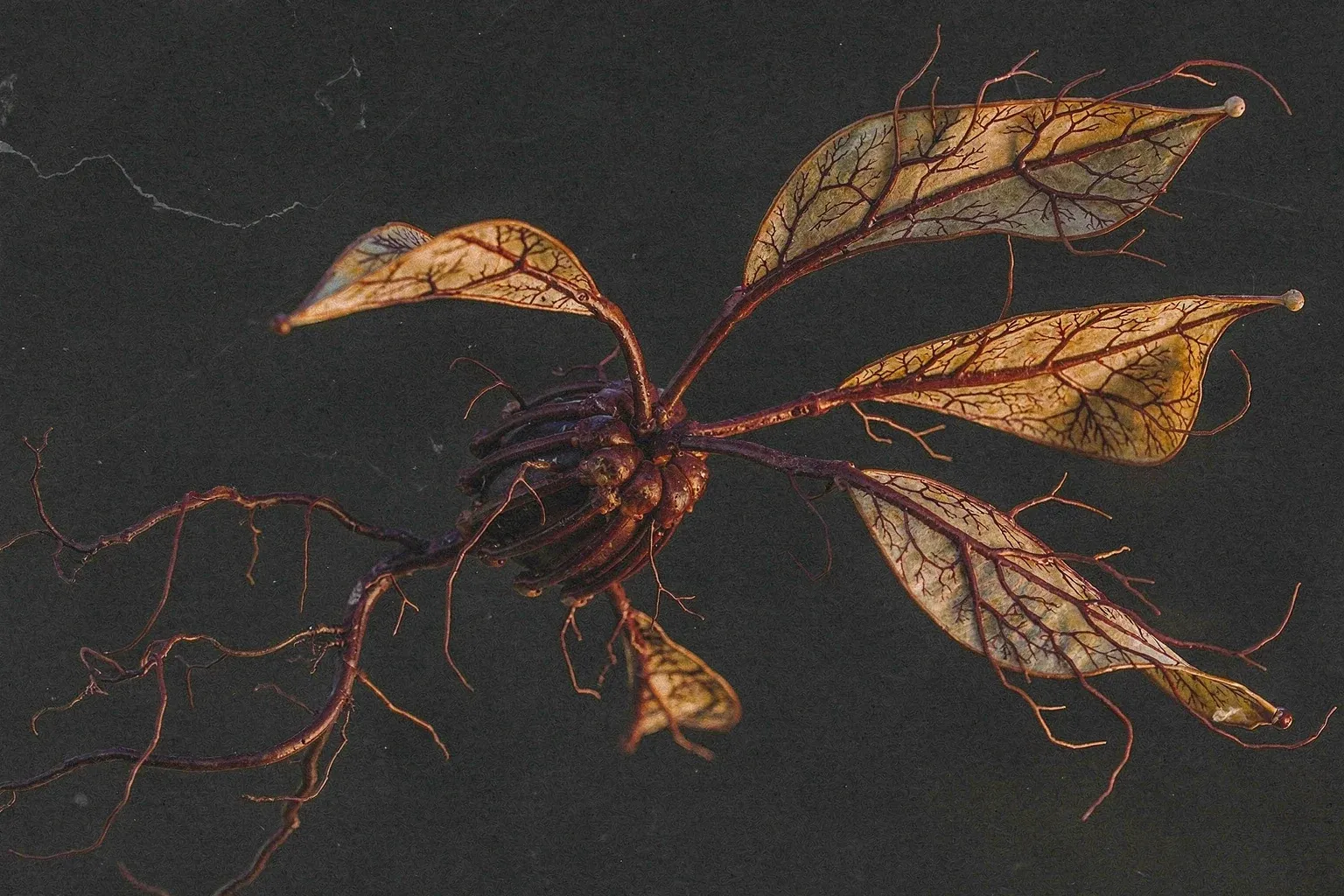
One generated still from the plant-to-motion series, the Capillary sail, animated five times with an image-to-video model. A pilot and three audited revisions gave only modest variations of leaf flex, light and haze; a fifth test asked for a different action, travel across the frame.
Process article prepared with Hermes, an AI-assisted workflow, from the saved generation record in response to John's direction and feedback. It is not John's first-person writing.
This note continues the process that began in From seed to structure and continued in From plant to motion. Those two articles traced invented organisms through 31 still images whose prompts kept asking for movement, so John asked to see one actually move. A five-second pilot made from one still moved so little that John asked for it to be pushed until the scene felt alive. Three revisions followed. Seen together, John’s reaction was that they all seem fairly similar, and that is the honest reading: they are modest variations of small leaf flex, light and haze on the same still, not convincing life and not a demonstrated improvement on the pilot. So a fifth clip asked for a different kind of action: the organism travelling across the frame. That action test is the clip above, published with John’s approval; the pilot and three revisions are below it.
As in the earlier notes, John chose the direction and reviewed the results. The prompts were written by the AI-assisted workflow, and each is reproduced exactly in the records at the end of this page.
Which still, and why
The source is Capillary sail, from the vascular stage of the follow-up: a dark ribbed core with parchment leaf-sails traced in rust-red veins, and long root filaments trailing to the lower left. It descends from Glider, the study that was meant to drift.
The model, FLUX.3 Video from Black Forest Labs through OpenRouter, takes an image as the first frame and continues from it. The frame sent was the published WebP version of the still on this site, not the original PNG, so the record keeps both hashes apart. All five clips started from that same frame.
The pilot
The pilot prompt described the organism’s anatomy in time: which parts should move, in what order, and how fast.
The two broad translucent membranes slowly flex and unfurl around their ribbed stems, then partly relax. Fine trailing root filaments curl independently with a slight delay.
The rest was mostly constraint: no new anatomy, no changing backgrounds, and a locked camera.
Locked-off camera: no zoom, pan, cut or camera shake.
The movement that came back is restrained: the leaf-sails flex a little and some filaments shift, the core stays almost still, and no pulse along the veins can be confidently seen. The model reframed the 3:2 still to fill a 16:9 shot.
Three revisions
John’s reaction to the pilot was that it looked like a picture with a part moving, because nothing around the organism changed. The locked camera stayed, since a pan would be easy to mistake for the subject moving, but each revision dropped the ban on changing backgrounds.
Each clip after the pilot was an independent request from the same first frame with a rewritten prompt, not a continuation. The model takes no seed, so differences cannot be pinned on the prompt alone: this is a sequence of attempts, not a controlled experiment. Each clip was played through, with frames sampled each second, before the next prompt was written.
Revision 1, light. Five seconds again, asking for the light to move rather than only the leaves:
During this motion a soft off-screen amber light shifts gradually from upper right toward side right, changing which translucent membranes catch the light.
The silhouette changed slightly, but no strong change of light was visible and the background stayed mostly inert.
Revision 2, scene. Eight seconds, with timed movement and one shared cause behind the light:
Over seconds one through four its large right-hand leaf-sails visibly curl inward and then spread back out, with a clear change of silhouette and foreshortening.
The right-hand sails curl and spread into a somewhat different pose, the largest change of shape among the four, but the core stays where it was. The background stayed almost black.
Revision 3, environment. The environment became the subject, with a draft whose evidence had to be visible:
A slow warm draft arrives from offscreen right. Its visible evidence is a thin layer of charcoal mist moving behind and around the organism, several fine amber dust motes traveling diagonally at varied depths, and all the leaf-sails responding with bending then partial reopening.
The sails partly close and reopen, and a warm haze rises from the right while the field brightens; the core and roots stay in place. It was picked at the time as the liveliest, but side by side the difference is mostly light and haze, not what the organism does. The amber is also stronger than in the still.
An action test
Rather than refine the atmosphere again, the fifth request asked for something qualitatively different: locomotion. It kept five seconds, the camera still and the materials, but released the exact pose:
Seconds 1 to 4: the whole folded body lifts and travels from left to right across the frame by roughly one width of its folded body, staying within the frame;
This time the organism does change place. Frames at each second show the core moving from a little left of centre to about seven tenths of the frame width, while marks on the charcoal stay fixed, so it is not a camera move. The sails swing up and fold, and the roots trail behind. The faults are plain too: around two seconds the sails smear with motion blur, there is no visible lift, it is still gliding at five seconds instead of settling, and at the end the right-hand sails are cut off by the frame edge. A single unseeded clip is not proof that this kind of prompt works; heavier identity constraints might have limited the earlier clips, but that was never tested.
| Clip | Intended change | Visible outcome | Next prompt |
|---|---|---|---|
| Pilot | Membranes flex and unfurl; vein pulse; nothing else changes | Small leaf flex; frozen charcoal; no clear pulse | Keep the camera locked, let the light move |
| Revision 1 · light | Off-screen amber light drifts | Slight silhouette change; no strong light change | Eight seconds; haze and a passing light |
| Revision 2 · scene | Sails curl and spread on a timeline; faint haze | Somewhat new pose on the right; core in place; background almost black | Make the draft, mist and motes visible |
| Revision 3 · environment | A draft and moving light acting on the sails | Sails partly close and reopen; warm haze; strong amber | Stop refining atmosphere; ask for a different action |
| Action test · travel | Fold, travel left to right, settle elsewhere | Core travels about a quarter of the frame; blur near two seconds; no lift or settle; sails cut at the right edge | Approved by John for publication; nothing further generated |
What the clips are
These are animated speculative art, not a living thing, and do not show how a real plant moves or how fluid circulates. There is no post-production: no effects, overlays or particles were added, and the copies here are web re-encodes at the returned size, not upscaled.
Settings and cost
The pilot request asked for five seconds at 720p, 16:9, with no audio. The model returned 5.04 seconds at 1280 × 704 pixels, 24 frames per second, with no audio track. The first revision and the action test made the same request; the second and third asked for eight seconds and returned 8.04. The records below keep requested and returned settings apart, with hashes.
The pilot, one clip, cost $0.85 in returned API usage. The three revisions cost $3.57 ($0.85, $1.36 and $1.36), so the original four clips on this page cost $4.42; the action test added $0.85, making $5.27 for the five shown. In order, the experiment began with six initial clips at $5.10: the pilot and five clips of other organisms from the series, which are not shown and have not been approved for publication. The three revisions brought it to $8.67 over nine clips, and the action test to $9.52 over ten, within a $10 cap. The source still was billed in the follow-up; its totals are unchanged. No seed was supplied, because the model does not accept one.
Pilot and earlier revisions
Video record
Generated video: one short clip made with an image-to-video model from a generated still. It is not footage of a real organism, and it shows animated speculative art, not real movement, feeding or circulation.
- Model
- black-forest-labs/flux-3-video (FLUX.3 Video) via OpenRouter
- Mode
- image-to-video, first frame; no seed supplied
- Clips
- 1
- Recorded cost
- $0.85. API cost of the one clip shown here, from returned usage. The source still was generated and billed in From plant to motion and is not counted again.
Capillary sail, first motion
- Requested
- 5 s, 720p, 16:9, no audio
- Returned
- 5.04 s, 1280 × 704, 24 fps H.264, no audio, 6.3 MB
- On this page
- 1280 × 704, 3.1 MB: libx264 CRF 20, preset medium, yuv420p, faststart, audio removed, metadata stripped; same 1280 × 704 frame size, not upscaled. Download MP4
- Source still
- Original PNG
a4df743cfa355540d971d936ffdf483d91255413b82a5509cecf8011cc2c62d1 - First frame sent
c586407ca7c16b316027cc1cdb590086d86291e1d9a497ee3efa2a09d4dec8ad. The first frame sent was the published 1536 × 1024 WebP derivative of the still served by this site, not the original PNG; its hash differs from both the original PNG and the repo intermediate.- Returned video
b69df469a40df249d0fceeadbe5e1ab69e666e01dc59cc12afd95bf147265920- Cost
- $0.85
Prompt
Animate this exact speculative botanical organism from the provided first frame. Locked-off camera: no zoom, pan, cut or camera shake. Preserve its identity, bone-and-bronze matte surfaces, fine grain, dark charcoal background, amber sidelight and subtle burgundy vessels. The organism itself must visibly move, not merely the camera or film grain. Keep all existing appendages and their attachments coherent; no extra limbs, faces, eyes, blood, wounds, gore, new objects or changing backgrounds. Quietly uncanny living behavior. One continuous five-second shot, natural slow articulated motion with a short rest. The two broad translucent membranes slowly flex and unfurl around their ribbed stems, then partly relax. Fine trailing root filaments curl independently with a slight delay. Its central stalk sways subtly; a restrained darker pulse travels along the existing red veins without glowing or changing their pattern. Movement should be clearly visible while the existing seed-form remains recognizable.
Generated via OpenRouter with Black Forest Labs FLUX.3 Video. Use is governed by those providers' terms at generation time; terms have not been separately reviewed.
Audit record
Generated video: three revisions of the Capillary sail pilot, each audited before the next prompt was written, and one later action test. They are not footage of a real organism and show animated speculative art, not real movement, light or circulation.
- Model
- black-forest-labs/flux-3-video (FLUX.3 Video) via OpenRouter
- Mode
- image-to-video, first frame. Each revision is an independent request from the same published first frame as the pilot with a rewritten prompt; it is not a video continuation of the pilot, and with no seed it is not a controlled experiment; no seed supplied
- Clips
- 4
- Recorded cost
- $4.42. API cost of the four clips in this record, from returned usage: three revisions at $3.57 and the action test at $0.85, $4.42 together. Before the action test, the pilot and three revisions shown here also cost $4.42; with it, the five clips on this page cost $5.27. The whole experiment cost $9.52 for ten clips: six initial clips at $5.10 (the pilot, and five other clips of other organisms that are not shown or approved for publication), the three revisions, which brought it to $8.67, and the action test.
- Post-production
- None: no effects, overlays, grading or particles were added; the web copies are re-encodes only.
Capillary sail, revision 1: light
- Requested
- 5 s, 720p, 16:9, no audio
- Returned
- 5.04 s, 1280 × 704, 24 fps H.264, no audio, 6.7 MB
- On this page
- 1280 × 704, 3.3 MB: libx264 CRF 20, preset medium, yuv420p, faststart, audio removed, metadata stripped; same 1280 × 704 frame size, not upscaled. Download MP4
- Source still
- Original PNG
a4df743cfa355540d971d936ffdf483d91255413b82a5509cecf8011cc2c62d1 - First frame sent
c586407ca7c16b316027cc1cdb590086d86291e1d9a497ee3efa2a09d4dec8ad. The first frame sent was the published 1536 × 1024 WebP derivative of the still served by this site, not the original PNG; its hash differs from both the original PNG and the repo intermediate.- Returned video
9fbcf082799ae0fc5d1bfd0b28ebfc8227ece91e174e1a836d59c853eea06ace- Cost
- $0.85
- Intended change
- Keep the pilot's small leaf flex but move the light: an off-screen amber source drifting from upper right to the side, so highlights and fold shadows travel across the sails and the charcoal is no longer absolutely frozen.
- Audit
- The organism stays recognisable and the sails flex in a small cycle, with a slight change of silhouette. No strong change of light could be seen in frames sampled each second or in playback; the background stays mostly inert.
- Next prompt
- Ask for a whole scene rather than a light cue: eight seconds, larger and clearly timed sail movement with a changed silhouette, plus faint haze and an amber pass that rises and recedes as one shared cause.
Prompt
Image-to-video revision of Capillary Sail. Preserve the exact recognizable organism and its fine grain, matte bone and bronze, amber light and burgundy vein tracery from the supplied first frame. No extra appendages, eyes, faces, wounds, blood, gore, text or cuts. One continuous five-second scene. Fixed framing and stable camera; motion must occur in the creature and lighting rather than a zoom or camera shake. Make the organism feel present in a changing physical environment without changing its identity. The thin leaf-sails flex in a clearly visible small cycle, curling slightly inward then opening and settling; their ribbed stems bend without detaching. Fine root filaments lag behind the main movement and tremble lightly. During this motion a soft off-screen amber light shifts gradually from upper right toward side right, changing which translucent membranes catch the light. Highlights migrate across the same ribbed surfaces and red veins; soft occlusion shadows inside folds change coherently as they flex. Background charcoal remains uncluttered, but the ambient light gently changes across it rather than being absolutely frozen. Keep illumination restrained and natural, not glowing vessels, flashing or dramatic spotlights. At the end the sails relax; no seamless loop required.
Capillary sail, revision 2: scene
- Requested
- 8 s, 720p, 16:9, no audio
- Returned
- 8.04 s, 1280 × 704, 24 fps H.264, no audio, 11.5 MB
- On this page
- 1280 × 704, 5.2 MB: libx264 CRF 20, preset medium, yuv420p, faststart, audio removed, metadata stripped; same 1280 × 704 frame size, not upscaled. Download MP4
- Source still
- Original PNG
a4df743cfa355540d971d936ffdf483d91255413b82a5509cecf8011cc2c62d1 - First frame sent
c586407ca7c16b316027cc1cdb590086d86291e1d9a497ee3efa2a09d4dec8ad. The first frame sent was the published 1536 × 1024 WebP derivative of the still served by this site, not the original PNG; its hash differs from both the original PNG and the repo intermediate.- Returned video
523eb001fec2fb03d77b612c6645086c10ffd59732cf639a44f7593e3f7059de- Cost
- $1.36
- Intended change
- Make the movement unmistakable and give it a scene: right-hand sails curl in and spread out with a changed silhouette, the core lifts and tilts, roots trail as if in a current, while faint haze drifts and a soft amber light passes over the membranes.
- Audit
- The right-hand sails curl and spread into a somewhat different pose, and the timing between leaves varies, but the core stays in place: a flex, not a change of position. The atmosphere hardly registers: the background stays almost black, and the haze and motes asked for are not clearly visible.
- Next prompt
- Make the environment the subject: one warm draft from the right whose evidence is visible mist, amber motes and a broad light shaft crossing the background, with the sails responding to it. Say outright that the charcoal must not stay frozen.
Prompt
Bring the provided Capillary Sail botanical entity to visibly animated life in one continuous eight-second cinematic study. Maintain the same recognizable central ribbed seed core, attached parchment leaf-sails, red vein tracery and long root filaments. Preserve grainy matte bone/bronze, dark charcoal, low amber light. Animate a coherent scene, not a still-image slideshow or uniform image warp. Keep framing stable, no camera cuts, no spinning camera, no new limbs, eyes, faces, text, gore or prey. No bright magic glow. At first the organism is still. Over seconds one through four its large right-hand leaf-sails visibly curl inward and then spread back out, with a clear change of silhouette and foreshortening. The thin stems bend at their attachments, the compact core slowly lifts and tilts by a small but noticeable amount, and loose roots trail behind with delayed motion as if carried by a gentle air current. Over seconds four through eight it relaxes and adjusts again, with one small leaf moving after the others rather than all moving in sync. In the surrounding scene, very faint low-contrast charcoal haze drifts slowly from left to right behind the subject and catches occasional warm motes, barely visible. A broad soft amber illumination passes gradually over the membranes and then recedes: highlights, translucency and shadows vary with the actual flexing surfaces. Darker folds appear as sails curl; they brighten at opening. This is one shared environmental cause, not strobing or random independent effects. Keep the background dark and uncluttered but not frozen; preserve subtle contrast and tactile grain. The vessel network remains fixed to the membranes, without claiming fluid simulation. Do not invent new anatomical parts. Allow the end pose to differ from the start; no forced seamless looping.
Capillary sail, revision 3: environment
- Requested
- 8 s, 720p, 16:9, no audio
- Returned
- 8.04 s, 1280 × 704, 24 fps H.264, no audio, 13.8 MB
- On this page
- 1280 × 704, 6.2 MB: libx264 CRF 20, preset medium, yuv420p, faststart, audio removed, metadata stripped; same 1280 × 704 frame size, not upscaled. Download MP4
- Source still
- Original PNG
a4df743cfa355540d971d936ffdf483d91255413b82a5509cecf8011cc2c62d1 - First frame sent
c586407ca7c16b316027cc1cdb590086d86291e1d9a497ee3efa2a09d4dec8ad. The first frame sent was the published 1536 × 1024 WebP derivative of the still served by this site, not the original PNG; its hash differs from both the original PNG and the repo intermediate.- Returned video
47532b40b75ce63a9b805443283ec148b404da6262a9100d8b0a705d11948589- Cost
- $1.36
- Intended change
- Let a shared environment act on the organism: a warm draft from off-screen right, seen as charcoal mist, amber motes and a broad light shaft moving toward the centre, with every sail bending and partly reopening at its own time.
- Audit
- The sails partly close and reopen, and warm haze enters from the right and spreads as the field and membranes brighten; motes are visible. The core and roots stay in place, so the difference from the earlier clips is mostly light and haze. Trade-offs: the amber becomes stronger than in the still, and some upper leaf tips approach or cross the top of the frame.
- Next prompt
- Seen beside the pilot and the other revisions, the four clips are modest variations rather than a demonstrated improvement. Rather than refine the atmosphere further, the next test asks for a different action: the organism travelling across the frame.
Prompt
Use this image as the opening frame for an eight-second continuous cinematic animation of the SAME Capillary Sail entity. Keep its anatomy, vessel pattern, parchment sails and bone/bronze grainy material recognizable. Camera fixed in position. No cuts, no zoom, no invented body parts, no faces or eyes, no blood or gore, no text. The first frame is static, but the following scene must develop clearly visible coherent subject and ENVIRONMENT motion. A slow warm draft arrives from offscreen right. Its visible evidence is a thin layer of charcoal mist moving behind and around the organism, several fine amber dust motes traveling diagonally at varied depths, and all the leaf-sails responding with bending then partial reopening. Large right-hand sails visibly rotate and curve, not just flutter at the tips. Root filaments trail with a delay. Simultaneously a broad soft warm shaft of light moves slowly across the background from right toward center, revealing and then losing the faint haze; the light creates a gradual brighter amber interval on the translucent membranes and a darker interval as they turn away. Shadows between leaves change with their positions. Grain remains fine and consistent, no full-frame brightness flicker, no neon effects. Keep the original seed core stable in identity and all roots attached. Briefly settle then make another small independent adjustment, different timings on different leaves. Do not keep the charcoal background frozen: drifting atmospheric haze and slowly passing light must be visible but tasteful. The scene should feel like a shared physical environment acting on a living botanical entity. Not a slideshow, not a uniform warp, not a static photograph with only particles drawn on top. Allow end pose to differ; no forced loop.
Capillary sail, action test: travel
- Requested
- 5 s, 720p, 16:9, no audio
- Returned
- 5.04 s, 1280 × 704, 24 fps H.264, no audio, 8.7 MB
- On this page
- 1280 × 704, 4.3 MB: libx264 CRF 20, preset medium, yuv420p, faststart, audio removed, metadata stripped; same 1280 × 704 frame size, not upscaled. Download MP4
- Source still
- Original PNG
a4df743cfa355540d971d936ffdf483d91255413b82a5509cecf8011cc2c62d1 - First frame sent
c586407ca7c16b316027cc1cdb590086d86291e1d9a497ee3efa2a09d4dec8ad. The first frame sent was the published 1536 × 1024 WebP derivative of the still served by this site, not the original PNG; its hash differs from both the original PNG and the repo intermediate.- Returned video
475546091585a6a97dfadab4e2b948794e863ea16fccc6987481c81c54369626- Cost
- $0.85
- Intended change
- A different kind of action rather than subtler atmosphere: with the camera still, the sails fold and the roots draw in, the body lifts and travels left to right by about one folded body width, the sails open once in a rebalancing beat, and it settles in a new place and pose.
- Audit
- The organism visibly travels left to right: the core moves from a little left of centre to about seven tenths of the frame width, roughly a quarter of the frame, while marks on the background stay fixed, so this is not a camera move. The sails swing upward and fold early and the roots trail behind. Faults: around two seconds the sails smear with motion blur; there is no clear lift, the body glides at the same height; it is still moving at five seconds rather than settling; and in the last second or so the right-hand sails are cut off by the frame edge, while upper sail tips also reach the top edge, although the prompt asked it to stay within the frame. Leaf arrangement re-forms rather than staying the still's pose, as the prompt allowed.
- Next prompt
- John approved publishing it with its faults. Nothing further was generated; the $10 cap leaves $0.48, less than another clip.
Prompt
Image-to-video action test starting from the provided first frame of the Capillary Sail botanical entity. Keep the same materials and identity: grainy matte bone-and-bronze surfaces, dark ribbed seed core, parchment leaf-sails with burgundy vein tracery, red-brown root filaments, amber light on a dark charcoal ground. The exact pose does NOT need to be kept; the organism should end in a visibly different pose and place. Camera completely stationary with stable framing: no pan, zoom, tracking, shake or cut, so that any travel across the frame is the organism itself moving. One continuous five-second shot. Second 0 to 1: the leaf-sails fold inward noticeably toward the core and the root tendrils pull up beneath the core. Seconds 1 to 4: the whole folded body lifts and travels from left to right across the frame by roughly one width of its folded body, staying within the frame; the trailing roots follow with a visible delay; the leaf-sails open once in a single propulsive, rebalancing beat and fold again. Seconds 4 to 5: it settles into a clearly different position to the right of where it started, in a different pose. Preserve the existing parts and keep every leaf and root attached to the core; no extra eyes, limbs, faces, mouths, second organism, new creature, blood, gore, text or neon effects. The action must not be only particles, haze, light changes or camera movement. A minimal dark environment with soft slowly moving light is optional and secondary; the primary action is an unmistakable frame-to-frame change in the position of the core and the pose of the body.
Generated via OpenRouter with Black Forest Labs FLUX.3 Video. Use is governed by those providers' terms at generation time; terms have not been separately reviewed.